Many deteriorated culverts can be rehabilitated in place by lining the existing barrel, thereby avoiding excavation of the road or rail embankment and keeping traffic moving. Replacement is the better choice when a culvert is too small for the flows it must carry, blocks fish passage, has lost its shape, or sits in an embankment that is already failing. The right answer depends on the barrel’s condition, its hydraulic capacity, the watercourse it crosses, and the cost of closing the road or track above it.
This guide explains how culverts fail, what a condition assessment should tell you, which rehabilitation methods suit which problems, and when replacement is worth the extra disruption. It builds on our broader guide to pipe rehabilitation vs. replacement and focuses on the issues unique to culverts under roads and railways.
Why a culvert is not just another buried pipe
A culvert carries water under a road, railway, or access route, but it also supports the embankment and the traffic above it. That combination changes the decision in several ways.
It works as part of a watercourse. Many culverts carry creeks and drainage channels, not just runoff. Their inlet and outlet shape how water, sediment, ice, and fish move through the crossing.
It carries live loads. Highway trucks, haul trucks, and trains load the pipe through the fill above it. Shallow cover and heavy loads leave less margin for deterioration.
Failure can be sudden. When a culvert loses structural capacity or its joints open, water can erode soil from the embankment until the road surface or track bed collapses. A failed crossing can close the only access route to a community or an industrial site.
Work is regulated and seasonal. Because many culverts sit in fish-bearing watercourses, work in the channel is subject to environmental requirements and timing windows that do not apply to a sewer under a street.
How culverts deteriorate
Most culvert problems fall into a few patterns, and the pattern matters more than the age.
Invert corrosion and abrasion. Corrugated steel pipe (CSP) culverts commonly lose metal along the bottom of the barrel first, where water, sediment, and stones wear through the protective coating. Once the invert perforates, water can flow outside the pipe and carry away the bedding.
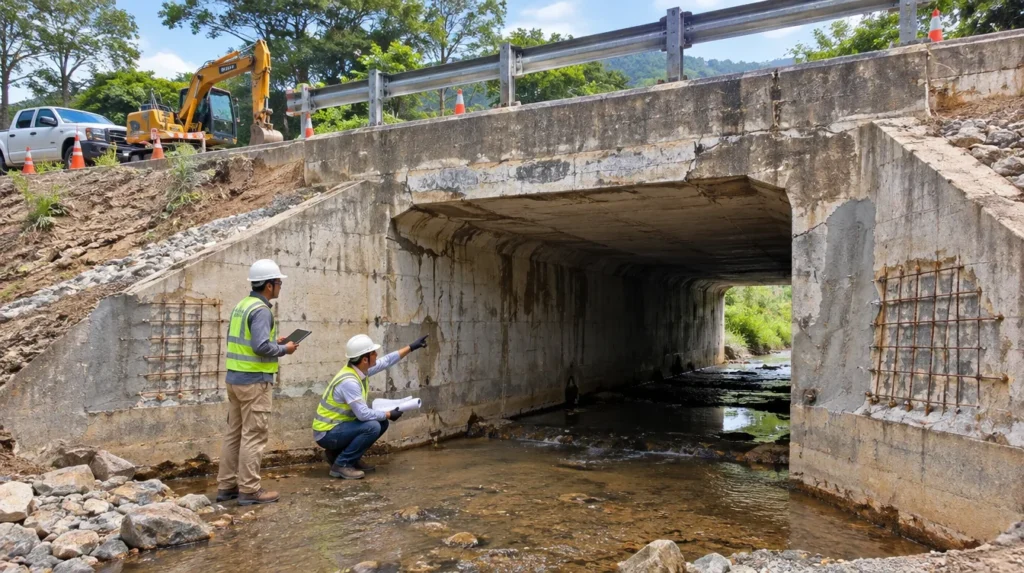
Joint separation and piping. Open joints in concrete or steel culverts let soil migrate into the barrel. Over time, this creates voids in the embankment, which often show up as settlement, cracking, or sinkholes in the road or track above.
Deformation. Flexible pipes that lose side support can deflect, flatten, or buckle. Moderate, stable deformation may still be compatible with lining. Severe or progressive deformation is usually not.
Inlet and outlet damage. Scour at the outlet can undermine the pipe end and leave it perched above the channel, which also blocks fish movement. Damaged headwalls, end treatments, and erosion protection let water attack the embankment.
Blockage and capacity loss. Sediment, debris, beaver activity, and ice can reduce the opening. A culvert that was adequately sized decades ago may now overtop more often as land use and rainfall patterns change.
Start with a culvert condition assessment
The rehabilitate-or-replace decision is only as good as the information behind it. A useful culvert assessment considers the entire crossing, not just the barrel.
- Barrel condition: section loss, perforations, joint condition, cracking and deformation, recorded by camera for small diameters or by direct inspection for larger ones. Entering a culvert can be a confined space under occupational health and safety rules, so inspections need to be planned with the right controls.
- Shape and alignment: measured deflection, sags, and changes in grade along the barrel.
- Embankment and surface: settlement, voids, sinkholes, cracking and seepage in the road, shoulder or track bed above.
- Ends and channel: headwalls, end treatments, outlet scour, perched outlets, sediment build-up and erosion protection.
- Hydraulic performance: evidence of overtopping or ponding, upstream flooding history, and the culvert’s capacity compared with current design flows.
- Records and context: size, material, installation year, cover depth, traffic or rail loading, and any upcoming road or track work.
Together, these findings tell you whether the barrel can be renewed in place, whether the crossing is the right size and type, and how urgent the work is.
When culvert rehabilitation makes sense
Rehabilitation is usually worth evaluating first when:
- the barrel is deteriorated, but its shape is largely intact and stable;
- the culvert has enough hydraulic capacity to remain adequate after lining;
- there is no fish passage problem that a new crossing would need to fix;
- the culvert sits under deep fill, a busy highway or an active rail line, where excavation, detours or track closures are expensive; and
- the road or track above is not scheduled for widening, raising or realignment in the near term.
In these cases, lining can renew the crossing with limited disturbance to the embankment and the surface above.
Culvert rehabilitation methods compared
Several trenchless methods are used to renew culverts. The right one depends on diameter, shape, condition, and flow, and on whether the culvert needs a new structural barrel or protection for a sound one. Our article on trenchless pipe rehabilitation methods covers the general principles in more detail.
Slip lining. A smaller pipe, often made of high-density polyethylene (HDPE), is pushed or pulled into the existing culvert, and the gap between them is filled with grout. Slip lining is simple and widely used for culverts, but it reduces the internal diameter, so hydraulic capacity must be carefully checked.
Cured-in-place pipe (CIPP). A resin-saturated liner is inserted and cured inside the culvert, forming a close-fitting new pipe. CIPP keeps more of the original diameter than slip lining, but water control during installation and curing needs careful planning.
Spiral wound liners. Profiled strips are wound into a new liner inside the host pipe, and the annular space is usually grouted. These systems can suit larger diameters and some non-circular shapes.
Spray-applied and centrifugally cast liners. Cementitious, geopolymer or polymer materials are applied to the inside of the barrel. Depending on the product and design thickness, they may provide corrosion protection only or a structural lining. Structural performance should only be relied on where the system is designed and verified for that purpose.
Invert paving. For CSP culverts where corrosion is limited to the bottom of the pipe, a reinforced concrete invert can restore the barrel floor and extend service life at relatively low cost, provided the rest of the barrel is sound.
Most methods still require work at the ends, such as filling voids in the embankment, repairing headwalls or replacing erosion protection. Rehabilitation that ignores voids already formed around the pipe can leave the road at risk even after the barrel is renewed.
Check the hydraulics before you line
Every lining method reduces the culvert’s internal area. A smoother liner can offset some of that loss because water flows more efficiently over it, but the net effect varies with the method and the existing pipe.
The lined culvert should be checked against the design flow your agency, or railway, requires, with attention to headwater depth, overtopping risk, and outlet velocity. If the crossing already floods, or if upstream development or changing rainfall patterns have increased flows, lining may lock in an undersized structure for decades. In those cases, replacement with a larger structure or an additional barrel may be the better investment.
When culvert replacement is the right call
Replacement usually makes more sense when:
- the culvert is hydraulically undersized or overtops regularly;
- the crossing is a barrier to fish passage, for example because of a perched outlet, excessive velocities, or an undersized opening;
- the barrel has collapsed, is severely deformed or is still deforming;
- the embankment has significant voids, slope instability or erosion that would require excavation anyway;
- the road or track is being raised, widened or realigned; or
- whole-life costs favor a new structure once closures, maintenance and residual risk are included.
Replacement options range from a like-for-like pipe to a larger culvert, an open-bottom arch that keeps a natural streambed, or a short bridge. In busy corridors, installing a new pipe using trenchless methods alongside the old one can sometimes reduce the required closure.
Plan for approvals and timing early
In Alberta, the construction, maintenance, replacement, or removal of watercourse crossings such as culverts is governed by the Code of Practice for Watercourse Crossings under the Water Act. The code requires advance notice of the work, classifies water bodies, and sets restricted activity periods that protect fish during migration, spawning, and early development. Where fish or fish habitat may be affected, federal Fisheries Act requirements may also apply.
These rules shape the schedule as much as the design. In-stream work may be limited to a window that does not always align with the construction season, and replacement typically requires more in-channel work than lining. Building approvals and timing in the options analysis avoid choosing a solution that cannot be built when you need it. Requirements differ by province and by crossing, so confirm them for each site.
Compare options on whole-life cost
A fair comparison includes more than the construction price. For each option, account for:
- design, approvals and environmental monitoring;
- traffic management, detours or rail track time;
- water control and fish protection during construction;
- embankment repairs, end treatments and surface restoration;
- expected service life and future maintenance; and
- the risk that remains if the crossing is undersized or the embankment is not fully addressed.
Rehabilitation often wins where closures are costly, and the crossing is the right size. Replacement often wins where the crossing is undersized, blocks fish, or is part of a larger road or track project.
For Alberta towns, counties and municipal districts, the Local Road Bridge Program under the Strategic Transportation Infrastructure Program can fund engineering, maintenance, rehabilitation and replacement of bridge-size culverts on eligible local roads, with a 75% provincial and 25% municipal cost share. Applications are due by November 30 for funding in the following year.
How Avodahtec helps, from inspection to construction
Avodahtec is an independent engineering advisor. We do not install or sell any lining system or culvert product, so our recommendations are based on your crossing’s condition, hydraulics, approvals, and budget.
We inspect and assess culverts and their embankments, evaluate hydraulic capacity, compare rehabilitation and replacement options on whole-life cost and risk, and design the selected solution. We prepare specifications with clear installation, inspection, and acceptance requirements, support environmental approvals and tendering, and provide construction inspection and Engineer of Record services for road and railway culverts. Learn more about our transportation engineering, trenchless technology, and underground infrastructure services.
Frequently asked questions
Can a culvert be relined instead of replaced?
Often, yes. Culverts with a deteriorated but stable barrel and adequate hydraulic capacity are frequently good candidates for slip lining, cured-in-place pipe, spiral wound, or spray-applied liners. Culverts that are undersized, severely deformed, blocking fish passage, or sitting in a failing embankment are usually better replaced.
How long does a relined culvert last?
Structural liners are commonly designed for a service life of several decades, with some systems designed for 50 years. That is a design basis, not a guarantee. Actual life depends on the product, installation quality, abrasion, water chemistry, and maintenance.
Does lining reduce a culvert’s capacity?
Lining reduces the internal area, although a smoother liner can recover part of the lost capacity. The lined culvert should always be checked against the required design flow before a method is selected.
Do I need approval to work on a culvert in Alberta?
Work to construct, maintain, replace, or remove a culvert in a watercourse generally falls under the Water Act Code of Practice for Watercourse Crossings, which requires advance notice and compliance with restricted activity periods. Federal requirements may also apply where fish habitat is affected. Confirm the requirements for each crossing before scheduling work.
Book a free consultation
If you are weighing whether to reline or replace a culvert on your road network or rail line, an early conversation can identify the information you need and the options worth evaluating. Book a free consultation with Avodahtec to discuss your crossings and next steps.
Book a free consultation