Fire protection depends on a design that addresses the facility’s hazards and the way its systems work together. An independent fire protection design review assesses the documented fire strategy, detection, suppression, and life-safety provisions against applicable requirements before procurement or construction. It can help identify omissions and coordination issues in facilities with significant fire hazards or demanding evacuation needs. This guide explains what the review examines and where it adds value.
What is an independent fire protection design review?
An independent fire protection design review is a structured assessment of a project’s fire protection documentation by qualified specialists who were not involved in preparing the original design. Within the agreed scope, they assess the design against applicable codes, standards, and project requirements, then document gaps, discrepancies, and coordination issues. Reviewer qualifications should match the facility’s hazards and systems. The review supplements the designer’s checks; it does not transfer the engineer of record’s responsibilities or replace approval by the authority having jurisdiction.
What does a fire protection design review check
The review scope should establish which active systems, passive protection measures, and life-safety provisions will be examined, including their interfaces with other disciplines. The following are common review areas.
Fire strategy and code compliance. Whether the documented fire and life-safety approach addresses the hazards, occupancy, and requirements of the authority having jurisdiction (AHJ), using the applicable building and fire codes and referenced standards.
Detection and alarm. Coverage, device selection, and sequence of operation for fire detection and alarm systems, and their integration with other building systems.
Suppression systems. Whether sprinkler, water-spray, deluge, foam, or clean-agent systems suit the identified hazard. The checks use the criteria relevant to each system, such as coverage, water demand, agent concentration, discharge duration, or enclosure integrity.
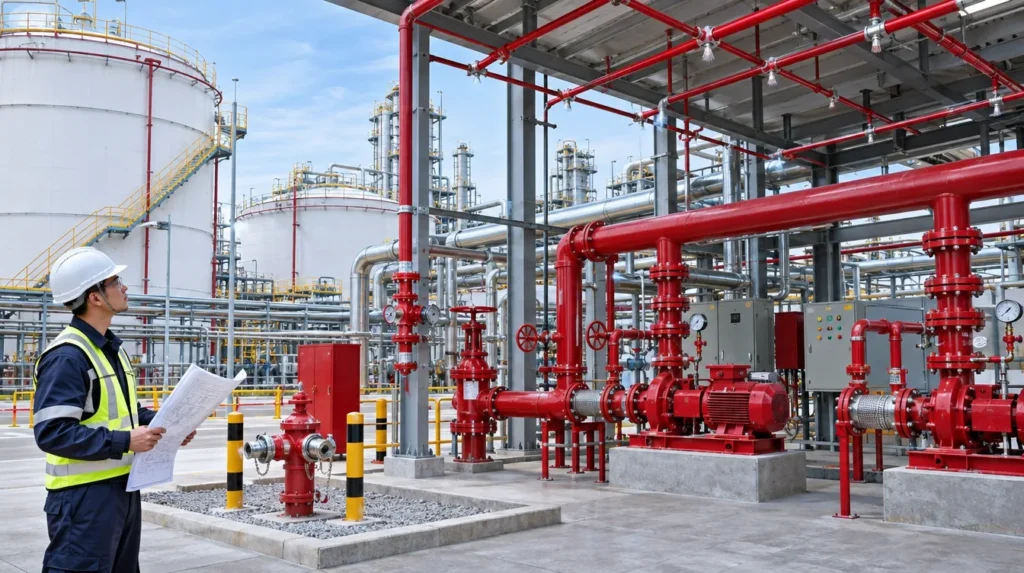
Water supply and hydraulics. Whether the documented supply conditions, pump selection, and hydraulic calculations support the required demand and duration, accounting for relevant simultaneous demands.
Passive fire protection. Whether specified fire-rated assemblies, separations, and penetration or joint protection maintain the required compartmentation and continuity, coordinated with architectural and structural documents.
Egress and interfaces. Whether the documented escape provisions and smoke-control sequences align with the fire strategy, including fan operation, fire alarm signals, door controls, and emergency power where applicable.
Fire protection requirements often cross mechanical, electrical, architectural, and structural documents. A coordinated review should identify which interfaces are covered and who is responsible for resolving findings. We cover this approach in our guide to independent engineering design review.
Why an independent review, and why before construction
A missed separation distance, an inadequate water supply, or suppression criteria that do not suit the hazard can lead to redesign and field rework. A review before procurement or construction gives the design team an opportunity to address these findings before equipment and layouts are committed.
A reviewer who was not involved in preparing the design can question assumptions and assess the documented strategy from another technical perspective. That review complements internal checks. When retained by the owner, the reviewer can explain the findings and their implications for safety, operation, and project decisions.
Where fire protection design review matters most
Independent review is particularly useful where hazards, occupancy, or system complexity make design deficiencies consequential. These settings present different review needs; a hospital’s evacuation constraints, for example, differ from the flammable inventories of a refinery.
Battery energy storage systems (BESS). Battery chemistry, arrangement, thermal-runaway propagation, ventilation, gas hazards, fire protection, and emergency access need to be considered together. Relevant product listings and fire-test data should support the proposed installation; suppression alone should not be assumed to stop thermal runaway.
Data centres. Server and uninterruptible power supply (UPS) or battery rooms, cable penetrations, fire-rated assemblies, detection, and suppression require coordination with cooling, power, and operational continuity requirements.
Oil refineries and petrochemical plants. Flammable inventories, process equipment, fireproofing, firewater demand, drainage, and separation distances require a fire protection strategy suited to the process hazards.
Power plants and substations. Transformers, turbine areas, cable rooms, and lubricating-oil systems need fire protection measures matched to the equipment and operating hazards.
Chemical manufacturing plants. Hazardous-material storage, ventilation, containment, fire separation, explosion protection, and suppression.
Hydrogen production and fuelling facilities. Storage configuration, leak detection, ventilation, separation distances, electrical area classification, and fire protection must address the applicable hydrogen hazards.
Hospitals. Fire compartments, smoke barriers, medical gas systems, sprinkler coverage, and evacuation provisions need to support patient protection, including staged relocation or other approved strategies where appropriate.
High-rise buildings. Sprinklers, standpipes, fire separations, shafts, stairs, smoke control, and firefighter access need to support the building’s fire and evacuation strategy.
Warehouses and automated distribution centres. Commodity classification, rack configurations, storage heights, sprinkler criteria and obstructions, battery charging, and fire-department access influence the protection required.
Aircraft hangars. Aircraft fuel hazards, hangar operations, drainage, detection, separation, and suppression need to be checked against the applicable requirements. Sprinkler or foam systems are assessed where required by the selected design approach.
The codes and standards a review checks against
A fire protection review should identify the codes and editions applicable to the jurisdiction, along with project requirements and AHJ decisions. Depending on the facility, these may include building and fire codes and relevant NFPA, CSA, or CAN/ULC standards. The latest published edition is not necessarily the adopted edition. Specialized applications also require standards suited to their hazards and systems. Findings should cite the applicable requirement and distinguish a compliance concern from a recommendation based on engineering judgment.
What you receive from a review
The deliverable is a structured record of findings tied to the reviewed documents and revisions. Each finding should state the applicable requirement or engineering basis, its priority, the potential consequence, and the action or clarification needed. Where response review is included, the register tracks the designer’s replies, revised documents, and closure status. Unresolved findings, missing information, and review limitations should remain clear to the client.
How Avodahtec helps
Avodahtec provides independent fire protection design review as part of its multidisciplinary design QA/QC service. Our specialists assess the agreed documentation against project requirements and applicable codes and standards, then document findings for the responsible designers to address. We work with owners and developers, as well as design and engineering, procurement, and construction (EPC) firms seeking an external assessment. Where the engagement includes mechanical and electrical review, we also examine shared requirements such as smoke control, equipment power, and fire alarm interfaces.
For the full multidisciplinary approach, see our guide to independent engineering design review and our design QA/QC service.
Frequently asked questions
What is an independent fire protection design review?
A technical assessment of a project’s fire protection documentation by qualified specialists who were not involved in preparing it. The agreed scope may cover the fire strategy, detection, suppression, passive protection, and life-safety provisions against applicable requirements.
How is a review different from designing the system?
A designer develops the fire protection system and its supporting documentation. An independent reviewer assesses that design within an agreed scope and records findings for the responsible designer to address. The review supplements design checking and does not replace regulatory approval or the engineer of record.
When should a fire protection design review happen?
At appropriate design milestones and before relevant equipment is procured or drawings are issued for construction or fabrication. Allow time for findings to be addressed and for significant revisions to be checked.
Which facilities most need an independent fire protection review?
Facilities with significant hazards, complex systems, or demanding evacuation requirements, including battery energy storage, data centres, refineries, chemical and hydrogen facilities, power plants, hospitals, high-rise buildings, warehouses, and aircraft hangars. The scope and specialist expertise should match the application.
Book a free consultation
A fire protection design gap can affect several systems and become difficult to correct once construction begins. Avodahtec’s specialists provide a documented assessment of the agreed scope, helping your team address significant findings before they become procurement or installation problems.
Book a free consultation and we will help you scope an independent review for your project.