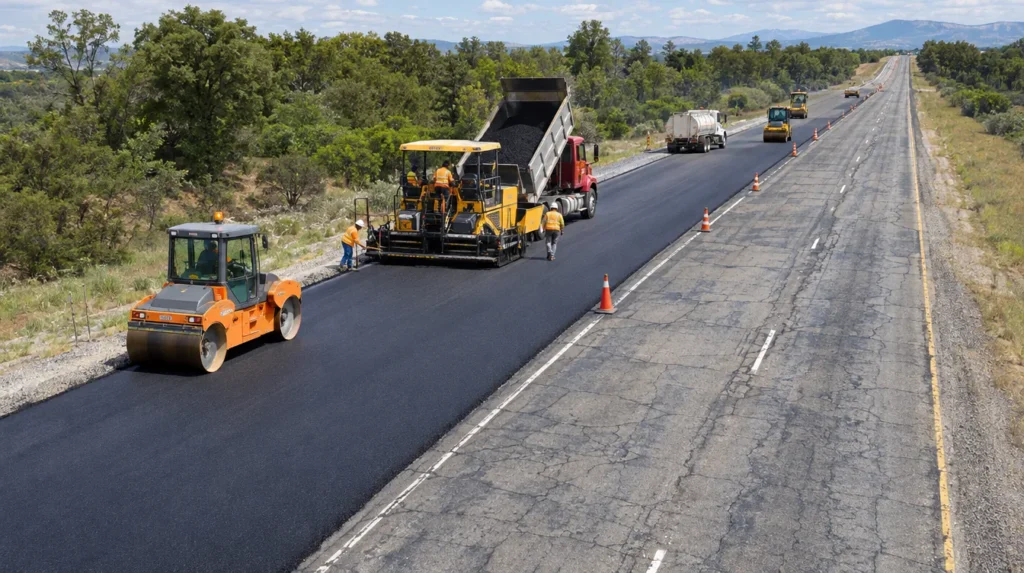
A pavement management program uses regular condition data to decide which roads to treat, with which treatment, and when. Its central idea is simple: keeping good roads in good condition with low-cost preservation treatments costs far less than rebuilding them after they fail. Municipalities that manage pavements this way can maintain a better network on the same budget and explain their choices to council and residents with evidence.
This guide explains why the “worst first” habit costs more, what a pavement management program includes, how to match treatments to condition, and how to turn condition data into a plan that council will support.
Why “worst first” costs more
Pavements do not deteriorate at a steady rate. A new road holds up well for years, then declines faster as cracks let water into the base and traffic loads take their toll. Once a road reaches poor condition, the remaining options are expensive: thick overlays, full-depth reclamation, or reconstruction.
A worst-first approach spends most of the budget on those failed roads, while roads in fair condition slip past the point where cheaper treatments would have worked. The result is a network that keeps getting worse even as spending stays the same. The US Federal Highway Administration has reported that each dollar spent on pavement preservation could save up to six dollars in future costs when treatments are applied at the right time.
The stakes are large. In Statistics Canada’s 2020 infrastructure survey, roads accounted for 48.1% of core public infrastructure in poor or very poor condition by replacement value, more than any other asset type.
What a pavement management program includes
A pavement management program does not need to be complicated, but it does need to be consistent. Most programs include the following building blocks.
Inventory. The network is divided into segments, each with its location, length, width, surface type, road class, traffic, and treatment history.
Condition survey. Each segment is rated for surface distress such as cracking, rutting, raveling, and potholes, and often for ride quality. The results are commonly summarized as a Pavement Condition Index (PCI), using a method such as ASTM D6433 for roads and parking lots. Surveys can be done on foot, by windshield rating, or with vehicle-based imaging, depending on the size of the network and the budget.
Performance prediction. Deterioration curves estimate how each type of road will decline over time, so the program can forecast condition rather than only report it.
Treatment strategies. Decision rules link condition, road class, and traffic to the most cost-effective treatment.
Budget scenarios. The program models how network conditions change under different funding levels, which is often the most useful output for the council.
Multi-year plan. The result is a prioritized list of roads and treatments for the next several years, coordinated with other capital work.
Matching treatments to condition
The best treatment depends on the condition of the road at the time it is applied. The table below shows typical relationships, although thresholds and treatment choices vary by agency, climate, traffic and pavement structure.
| Condition | Typical treatments | Purpose |
|---|---|---|
| Good | Crack sealing, fog seal, chip seal | Keep water out and slow aging of the surface |
| Fair | Micro-surfacing, thin overlay, mill and overlay | Restore the surface before structural damage sets in |
| Poor | Thick overlay, full-depth reclamation | Restore structural capacity |
| Very poor or failed | Reconstruction | Rebuild the base and surface |
Preservation treatments only work on structurally sound pavements. Sealing a road that has already failed in its base will not stop it from breaking up, which is why timing matters more than the treatment itself.
Drainage and what lies underneath
Water is the main enemy of a pavement. Blocked ditches, failing culverts, and poor crossfall allow water to soften the base, and no surface treatment can make up for a wet foundation. A good pavement program checks drainage during every condition survey and treats it as part of the solution. Our guide to culvert rehabilitation vs replacement covers the crossings that often sit at the heart of road drainage problems.
What lies under the road matters too. Paving a street and then cutting it open for a watermain or sewer repair a few years later wastes money and shortens pavement life. Before major paving, check the condition of the utilities underneath and coordinate renewal where it makes sense. Our article on pipe rehabilitation vs replacement explains how trenchless methods can renew pipes without disturbing new pavement.
Gravel roads need managing too
Rural municipalities across the Prairies maintain long networks of gravel roads, and those roads benefit from the same disciplined approach. A gravel road program tracks surface gravel loss, road shape and crown, drainage, and complaints such as wash-boarding and dust. It sets re-graveling cycles based on traffic and condition, and helps decide when traffic growth justifies upgrading a road to a paved or chip-sealed surface.
Turning data into a plan council will support
Condition data only creates value when it changes decisions. The most persuasive output of a pavement management program is usually a set of budget scenarios that show what the network will look like in five or ten years at current funding, at a higher level, and at a lower one. Council can then see the trade-off between spending and service rather than react to the latest complaint.
A pavement program also fits naturally into a broader asset management plan. Our article on infrastructure asset management explains how to prioritize renewal across roads, pipes and facilities when the capital budget cannot cover everything.
How often should roads be assessed?
Many owners survey their full network every few years, with arterial and high-traffic roads assessed more often than quiet local streets. The right frequency balances the cost of the survey against how quickly conditions change and how often the capital plan is updated. Updating treatment records every year keeps the program accurate between surveys.
How Avodahtec helps
Avodahtec is an independent engineering firm. We do not pave roads or sell treatment products, so our recommendations are based on your network’s condition and your budget.
We complete pavement condition surveys and PCI ratings, build or update road inventories, develop deterioration models and treatment strategies, and prepare budget scenarios and multi-year plans that council can act on. We work with the software and data you already have, and we can carry the plan forward into rehabilitation design, tendering, and construction inspection. Learn more about our transportation engineering, asset management, and reliability engineering services.
Frequently asked questions
What is a pavement condition index (PCI)?
A pavement condition index is a rating from 0 to 100 that summarizes the type, severity, and extent of visible distress on a pavement section, with higher numbers meaning better condition. ASTM D6433 sets out the procedure for roads and parking lots, and ASTM D5340 covers airport pavements.
What is the difference between pavement management and pavement maintenance?
Pavement maintenance is the work performed on roads, such as patching, crack sealing, or overlays. Pavement management is the process that determines which roads receive which work and when, based on condition data, costs, and priorities.
Is pavement preservation worth it on roads in poor condition?
Usually not. Preservation treatments such as crack sealing and chip seals are designed for structurally sound roads in good or fair condition. Roads in poor condition generally need rehabilitation or reconstruction instead.
Do we need special software to manage our pavements?
Not necessarily. Smaller networks can be managed well with a spreadsheet or GIS, while larger networks benefit from dedicated pavement management software. What matters most is consistent condition data and clear decision rules.
Book a free consultation
If your road budget is not keeping up with your network, a pavement management program can show where each dollar does the most good. Book a free consultation with Avodahtec to discuss your roads and next steps.
Book a free consultation