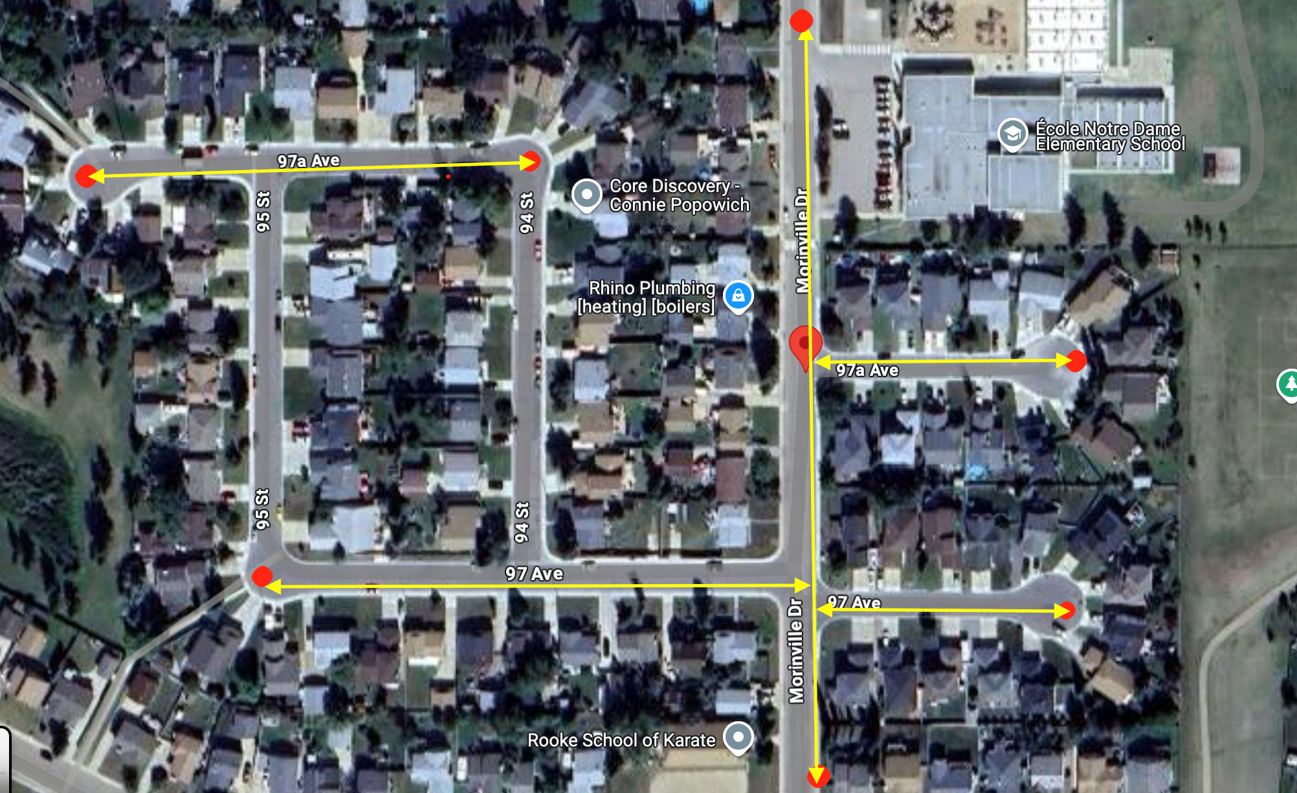
Town of Morinville Sanitary Sewer Condition Assessment Pilot Program
Pilot condition assessment of eleven sanitary sewer segments using CCTV data and risk-based scoring to identify maintenance priorities.
View Project
The project involves the condition assessment of four sanitary sewer segments from the Town of Stony Plain's recent CCTV inspection programs, applying Avodahtec's in-house Risk and Condition-Based Assessment Framework to identify structural risk and recommend clear next steps.
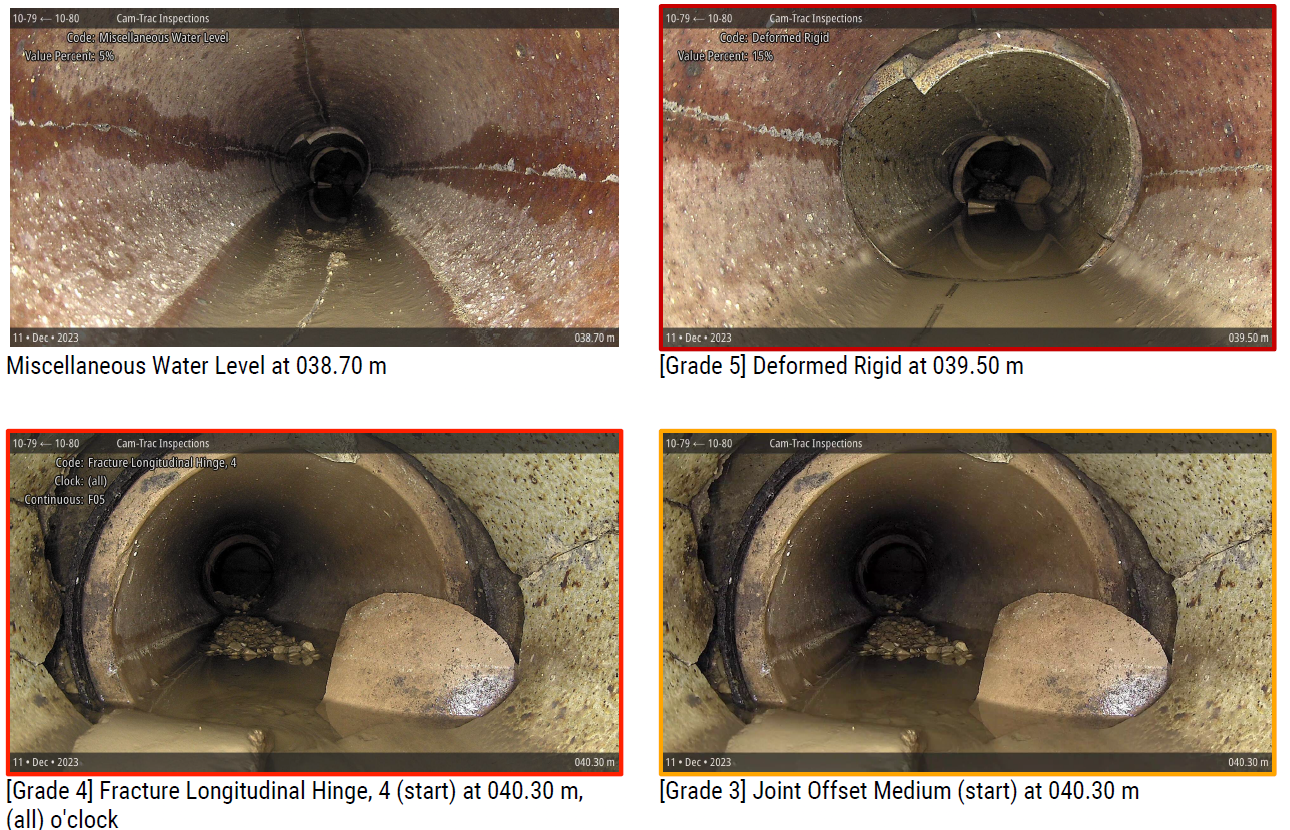
The Town of Stony Plain commissioned a CCTV inspection of selected storm and sanitary sewers, with all inspection work and reporting completed in accordance with the NASSCO Pipeline Assessment Certification Program (PACP) standard. To demonstrate the value of its Risk and Condition-Based Assessment Framework for Sewers, Avodahtec invited the Town to share a sample of this data for a pilot assessment. The Town provided CCTV inspection data for four 200 mm segments. The segments range in age from 12 to 66 years and include both vitrified clay (VCP) and PVC pipes. The assessment found a Grade 4 or 5 defect roughly every 17 m of inspected pipe, with significant structural distress in all four segments and the older VCP mains most severely affected.
4 Sewer Segments
Four 200 mm VCP and PVC segments built between 1959 and 2013, with 1.9 m to 3.7 m of cover
CCTV & PACP Data
CCTV footage, PACP inspection reports, and as-built drawings
NASSCO PACP
NASSCO PACP condition grading and Quick Ratings
PCOF & SSR Scoring
Avodahtec's Probable Contributor of Failure (PCOF) and Structural Severity Rating (SSR) scoring
About 30% of the network could not be inspected. On one segment, the survey was abandoned after only 16 m when a broken pipe with visible soil blocked the camera, leaving the remaining 89 m unassessed and likely in worse condition. The defects also differed by material, with brittle fractures and joint failures in VCP and deformation in comparatively young PVC pipe. Standard pipe rating indices, which average in low-severity defects, suggested the sewers were in fair condition. The Town needed an assessment that would surface the critical defects hidden in that average and support timely, defensible decisions before failures escalated.
About 30% of the network could not be inspected. On one segment, the survey was abandoned after only 16 m when a broken pipe with visible soil blocked the camera, leaving the remaining 89 m unassessed and likely in worse condition. The defects also differed by material, with brittle fractures and joint failures in VCP and deformation in comparatively young PVC pipe.
Standard pipe rating indices, which average in low-severity defects, suggested the sewers were in fair condition. The Town needed an assessment that would surface the critical defects hidden in that average and support timely, defensible decisions before failures escalated.
We compiled the CCTV footage, PACP reports, and as-built information for each segment, documenting age, material, depth, and location.
We quantified structural, operational, and maintenance (O&M) defects by type, grade, and frequency, and documented representative defects using CCTV imagery.
We calculated structural and O&M pipe ratings, rating indices, and Quick Ratings, showing how Quick Ratings revealed priorities that the averaged indices concealed.
We applied our modified PCOF and SSR scoring to filter out low-severity noise (Grades 1 to 3), identifying all four segments as requiring attention and two VCP segments as requiring immediate attention.
We explained the likely failure mechanisms for each pipe material and linked them to Stony Plain's variable glacial and lacustrine soils, groundwater fluctuation, freeze-thaw cycles, and traffic loading.
We recommended an Engineering Design Evaluation and Stability Assessment as the immediate next step, supported by a defect-specific matrix of repair and renewal options.
The pilot turned inspection data the Town already owned into decision-ready insights, with no new fieldwork required.
PCOF and SSR scoring exposed critical structural defects that averaged rating indices had masked.
Linking each defect to material behavior and local ground conditions explained why the sewers were failing, not only where.
Segment-level priorities and a defect-specific options matrix gave the Town a practical, proactive path forward.
The pilot demonstrated a repeatable approach that can grow into a full risk-based prioritization of the Town's sewer network.
Explore more of our work
Pilot condition assessment of eleven sanitary sewer segments using CCTV data and risk-based scoring to identify maintenance priorities.
View Project
An ergonomics assessment of the existing Little Potato Company wash line in Nisku to inform safer, more efficient design of the second processing line.
View Project
Engineer of Record services for ROV-based submerged inspections of six railway culverts across three Ontario rail subdivisions, translating video and sonar findings into risk-based engineering recommendations.
View Project